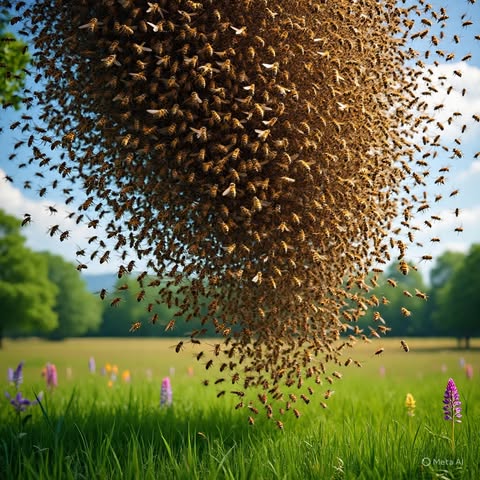
People sometimes criticise vegans for causing insects to be killed by farmers protecting crops, but this seems rather disingenuous when we notice that everyone kills insects all the time and they are killed in vast numbers both to protect human food crops as well as feed for livestock and even in livestock production itself.
One reason people bring this up is they think veganism is a doctrine of least or zero harm, but that’s not exactly true. Vegan principles are about freedom and aim to prevent unfair use of animals and their treatment as property (you can read more here about what veganism is really trying to achieve). Still, vegan ethics also ask that we do what we reasonably can to prevent cruelty to animals.
Given vegans can’t do much to influence farming methods and that killing insects to protect crops is necessary, it’s not wrong for vegans to demand food be protected from insects, just like most everyone else. Luckily, it’s likely far fewer insects are killed for a vegan lifestyle than otherwise. On average, such a diet will lead to less overall harm to animals than a typical consumer’s diet.
But do we even need to care that much, really? I’d suggest that we all intuitively recognise that insects can’t matter individually in all contexts – if they did, we wouldn’t drive cars, fly in aeroplanes, use pest sprays to control insects in our homes, control insects in our gardens etc. We are backed in thinking this by a couple of facts:
- Insects’ own lifecycle works on a numbers game – individuals don’t really count. What matters is species success. Insects are an example of what can be described as r-selected reproducers. In other words, insects have many offspring and invest little care in those offspring. If enough are created, then most can die so long as enough survive to maintain the species.
- Insects have limited “sentience”. While some may “feel” pain they have very much simpler emotional circuitry so we can’t say that their pain matters as much as say a cow’s. Insects have a much less rich inner experience than more complex animals.
The reason we might worry about many animals is that their form of sentience entails an internal awareness of, and personal relationship with, themselves and other members of their species. They can have emotions, motivations, preferences, attachments and so on. Such rich inner lives means they matter in and of themselves and they matter enough that for them, justice matters.
Most insects, on the other hand, do not have such rich inner lives and operate largely on essential behavioural routines to achieve their goals. Take ants, for example. Ants recognise each other by chemical signals – they can tell which ants belong to their colony and what roles they play. But that’s as far as it goes – they don’t think of a fellow ant as Ralph from next door.
For an ant colony, what matters is if there are enough ants to fulfill the colony’s essential functions. It doesn’t matter if 100 of them are killed by a bicycle running over them; no-one misses them individually. There are thousands of others to maintain the colony.
In the end, just as we accept killing cockroaches in kitchens, mosquitoes to prevent malaria, and termites to protect our homes when we must, and even by living our everyday lives (for example, over 200 trillion insects might be killed every year just from driving motor vehicles), we should not feel it’s wrong to kill insects to protect our food.
Of course, I’m not saying we shouldn’t care at all, just that when we have to kill insects to protect ourselves, our property and our food, we are not making an immoral choice. It is absolutely still worthwhile to make choices that minimise harms to insects when we can! And we can apply the Principle of Least Harm (an ethical principle whereby we should choose the least harmful of any two or more harmful options) to make wiser choices about what plant-sourced foods to buy, though it would be hard to say how much real world effect that might have.
****************************************
Don’t forget, no-one needs to be a vegan to adopt and apply vegan ethical principles in their daily lives to make a positive difference for other animals. If you’d like to know more, you can read my essay that offers a deeper dive into the meaning and application of vegan ethics at the link below:
Click here to access: Animals Matter – Veganism for Everyone (pdf, 466kb)

 Just Us Too