Farmers Defending Animal Welfare Miss the Point

Happy farmer with happy cow

Something I often see on social media is farmers objecting to vegan advocacy on the grounds that vegans know nothing about animal husbandry. Because vegans aren’t engaged in the business, the story goes, they don’t understand just how well farmers really do look after their livestock. Unfortunately, this criticism rather misses the point.

I think this happens because farmers don’t understand what veganism is really about and the fact that pretty much all vegan/animal rights activism focuses almost exclusively on how much animals are harmed in animal farming with graphic imagery and stories about grossly negligent behaviour by producers. Farmers therefore think that vegans are simply complaining about animal welfare.

The reason that this criticism misses the point is that veganism and animal rights are not focused solely on animal welfare but rather on the question of whether or not we should use animals in these ways. The objection from veganism is that animals are being farmed in the first place, not just that they may suffer and be harmed.

To put it simply, “Veganism recognises the inherent value and dignity of other species and aims to treat them fairly by our choices whenever we can.”

In this context, “fairly” means that animals should be free to live their own lives without human interference, whenever it’s possible for that to happen. An easy way to think about this is that veganism proposes that when we can we should want to protect animals’ interests to:

  • be free and able to live their own lives
  • be able to make their own choices about their own bodies
  • not be treated cruelly by humans

A farmed animal is not free and is regarded as property, they are not able to make their own choices about what they do and when, and they can often be treated cruelly. That’s really why people adopting vegan ethics might choose not to buy products from animal farming (eg meat, dairy, etc). They are rejecting the unfair use of other animals when we have alternatives, so how animal farming is done is not relevant when making that choice.

That said, how animals are treated is important so while people continue to use animals in farming and other industries, we should want the best possible welfare for them. While it’s absolutely reasonable for farmers to defend their practices (and we should encourage their best practice), remember that the best welfare in the world doesn’t address the overall objections of veganism. Only the abolition of animal farming would achieve that.

Is that possible? That’s not for me to say, but really it’s a little irrelevant to what people can do right now. Veganism is primarily a personal stance so it’s much more likely that someone can make choices that minimise their support for animal farming.

Summarising all this:

  • Veganism objects to the unfair use of other animals and regarding them as property when we can do otherwise
  • People who adopt vegan ethics typically don’t buy products from animal farming for that reason
  • They also don’t need to know how animal husbandry systems work to take that stance
  • Farmers can (and should) promote best practice welfare and that’s important, but it’s not addressing the real moral objection

Crop Deaths Revisited – Why a Vegan-Friendly Diet is Likely to be Least Harm

(Three minute read)

Lately it seems every vegan critic wants to point to animal deaths in cropping to expose the hypocrisy of vegans. Here, I provide a brief analysis of why this is not the criticism many think it is.

Summary:

To find out if more animals are killed for a typical vegan-friendly diet versus a typical omnivore’s diet, we are only interested in the number of animals killed on the area of land needed to grow crops to replace animal food in the omnivore diet (because animals killed to grow the crops we all eat is a shared cost). It turns out just one tenth of a hectare is required. Few useful estimates of the animals killed to grow crops can be found. One of the highest estimates came from Mike Archer in 2011 when he claimed 100 animals are killed per hectare per year. This means a vegan-friendly diet might cause about 10 animals to be killed each year to replace animals in someone’s diet. The average omnivore causes about 50-100 animals to be killed directly and some number of others as part of that process. On average then, a vegan-friendly diet is the least harm option.

*******************************************************

The Full Story:

First, a little background. Veganism is not just a diet but rather the idea that we should include other animals within the scope of our moral concern to treat others fairly and deliver them justice whenever we can. While many people believe that veganism is about doing the least harm or even no harm to animals. I would say it is not specifically trying to do that. It’s about doing what we can to be fair to other animals when possible. And sometimes, we have to harm other animals just like we sometimes must with other people. For example, very few people would say that we should not kill mosquitoes to protect people from malaria or that we should not cull wild populations when necessary. By the same token we can kill pests in agriculture when necessary so as to defend our food.

But let’s cut to the chase. Are more animals killed for someone to eat a vegan-friendly, plants-only diet than for someone to eat an omnivore diet? The answer is hard to untangle because no-one knows for sure. There just is not much empirical research. We do know that few large animals are killed incidentally in croplands from activities like harvesting and tilling. Many more are killed by farmers controlling pests, but here the evidence is very sketchy.

What studies have been done of animal mortality in croplands don’t find that many animals are killed in crop cultivation. Indeed, it’s relatively uncommon to find peer-reviewed research documenting such an outcome. Tellingly, a wheat farmer in the UK once blogged about this very problem, hoping to document the deaths of many animals in a year’s worth of production. He failed to record even one (ignoring invertebrates, though we will come to that concern).

It turns out that estimates of cropland mortality vary. This problem was originally noted in a famous paper by Steven Davis back in 2003. He found that just 15 animals per hectare are killed on US croplands. Later still, Professor Mike Archer from the University of New South Wales claimed up to 100 animals are killed per hectare in Australian wheat fields (this was later claimed to be an exaggeration and revised to just 1.27 animals per hectare). And a blogger called Farming Truth once argued that as many as 117 animals die per hectare in the US.

But raw numbers may be misleading. When we think about this problem, we can be confident that most people are eating a variety of foods of both plant and animal origin. People directly eat grains, seeds, nuts, fruits and vegetables as well as derived foods such as bread, buns, cakes, French fries, sugar, wine, beer, herbs and spices and so on.

So, very nearly all of us are eating plants. The animals killed to grow those plants is a shared cost. While Jack the vegan eats plants and as a result animals are killed to grow this food, Jill the omnivore does the same. If we want to find out if Jack overall causes more animals to be harmed, we only need to work out how many animals are killed for the plants needed to replace animals in his diet and compare that to how many animals are killed for Jill to eat animals in her diet.

Most estimates suggest Jill will eat somewhere around 50-100 animals per year, but it could be much higher (perhaps 200). This is because fish and other sea food (eg prawns) are animals too. And don’t forget, we could also include as part of her toll on other animals the pests (such as feral dogs, pigs and deer) killed by animal farmers and the by-catch and incidental deaths (eg macerated chicks) killed in the production of animal foods. Lastly, many of the animals people eat are raised in concentrated animal feed operations which are fed from crops often grown for that purpose. Farmers kill pests in all situations, whether when growing crops for human food, for animal feed, or raising animals for food.

Jack on the other hand needs about one tenth of a hectare of land to produce the plant food that could replace animals in his diet. Even when we use the highest estimate of 100 animals killed per hectare in croplands made by Mike Archer (and since shown to be an exaggeration), we find Jack will cause just 10 animals to be killed for his food.

It seems very likely that on average, Jack’s diet is the least harmful.

Wait, you say, what about all the invertebrates killed in crop farming? Well, this is an open question because we just don’t know enough. Many farmed animals are found in mixed systems that also grow crops, farmed animals kill other small animals by walking on them, farmers treat ruminants for lice/fleas and other parasites, and small animals are killed to grow feed for farmed animals, including growing and harvesting of hay and silage. Certainly, the numbers of such animals killed might be considerable. However, I think we don’t need to know this for sure because both kinds of diet demand the use of croplands. The question really is, do we use more cropland for a vegan-friendly diet or for a typical diet?

Well, luckily there has been research into this question. On average, the cropland footprint in the US for a plant-based diet is about 0.17 hectares per year (see, for example, Peters et al, 2016 – Carrying capacity of U.S. agricultural land: Ten diet scenarios), while that of a typical Western-style diet is around 0.34 hectares per year. Whatever the number of animals killed on croplands, the plant-based diet will cause fewer overall.

Also, veganism is not specifically concerned with every kind of animal. Sure people can take it that way, but realistically we are most concerned with sentient animals. Many invertebrates just may not be sentient in the ways that count. That doesn’t mean we should ignore the harm to invertebrate species or to the environment and biosphere, but those are different concerns. Concern for the fair treatment of sentient beings can co-exist with more general concerns about other matters, just as concern for human rights abuses doesn’t mean we can’t also worry about pollution of the oceans.

In the end it seems likely that a typical vegan-friendly diet is best if we want to reduce harms to other animals and be fairer to the sentient animals we farm.

That said, someone can certainly make choices that do even better if least harm is their only metric. For example, a carnivore dieter who takes considerable care to source their food from ethical and sustainable sources and thus can be confident that they have caused the deaths of just a handful of large animals in a year is on solid ground. On a rights-based stance that doesn’t necessarily fly but for many people, least harm as a principle carries weight.

Of course, what you choose to do is up to you.

Should Vegans and Animal Rights Advocates Support Better Welfare in Animal Farming?

The simple answer: Yes.

The longer answer: Many animal advocates express concern and outrage at the way animals are treated in even high welfare animal farming operations and certainly there are many examples where “welfare” practices are more about expedience and productivity than the well-being of the animals. However, while we can question some practices, the larger question is, should we openly encourage and support farmers to provide good welfare for their animals or is this tacitly endorsing animal exploitation?

At the heart of this question seems to be the idea of abolitionism vs welfarism, an idea that has been expressed most strongly by animal rights advocate Gary Francione and his stance against what he terms “New Welfarism”. Welfarism is the idea that animal use is acceptable, providing the animals are well cared for. Abolitionism on the other hand is the idea that the foundational right that other animals should attract is the right not to be property (ie to be free) and hence no animal use is morally acceptable, regardless of how well cared for the animals might be.

Welfarism does not necessarily demand an end to animal use, while abolitionism does. Francione worries that by combining the two ideas, we dilute the effectiveness of campaigning for animal liberation (ie, abolition of animal using industries). Such a combination he refers to as “New Welfarism”.

New welfarism is thus an approach which advocates for improving animal welfare whilst still aiming for animal rights and abolition of animal use. Francione is critical of this ‘soft option’ and argues that to ever achieve anything the animal rights movement needs to focus only the ultimate goal of total animal liberation and nothing else.

Moreover, Francione argues that by advocating for, and supporting, better welfare practices we are in essence condoning animal use. The idea that we should think that animal use is acceptable so long as the animals are treated well is a pernicious one to be resisted at all costs. Welfarists are not commited to abolishing animal use and hence have no place within a genuine rights-based framework.

Is this a reasonable strategy? My own view is that no, it isn’t because I believe it confuses welfare with welfarism. The former is entirely consistent with a rights-based framework for our relationship with other species, the latter disregards these rights. This is because when we worry about the wellbeing of animals we are not necessarily committing to the belief that their use and exploitation is acceptable.

To explain further, it is my view that we owe other species the same basic rights as we owe human beings, whenever we can do so (or choose to). The reason for the somewhat optional stance here is because for now, such rights are not formalised at law and hence the best any of us can do is choose to act as though these rights exist.

These basic rights – the rights to be free, in control of one’s own life and not to be treated cruelly – should serve to guide us in our actions. Because these three basic rights give rise to the concept of veganism (and indeed directly underpin the definition of veganism), vegans therefore are people who behave as though other animals have these rights (ie vegans seek to exclude – as far as is possible and practicable – all forms of exploitation of, and cruelty to, animals).

How does this guide us in relation to animal welfare?

Generally speaking, vegans will not support animal-using industries when they can choose otherwise because these industries typically violate all three basic rights. This lack of support usually takes the form of not buying products from animal-using industries so as to remove the stimulus for continued production.

If everyone followed this strategy, then clearly the animal-using industries would cease because economic support is withdrawn. However, for now this is not stopping animals being bred into the system and so there are animals in these industries whose most important basic rights have been violated. The only remaining right that people can help protect is their right not to be treated cruelly.

Therefore, while there are farmed animals, vegans seem to remain under a duty to advocate for better welfare in order to be consistent with the aim to prevent cruelty. By advocating for better welfare one is not endorsing the use of animals in animal-using industries but rather seeking to minimise violations of living animals’ rights (ie the right not to be treated cruelly). Of course, as noted above vegans are still not going to buy products from these industries, no matter how good the welfare.

We can see therefore that these industries would not continue just because these same non-consumers support their welfare efforts. On the other hand, a genuine welfarist – who argues that animal use is fine so long as welfare is fine – would continue to stimulate production with their economic support.

On these grounds, I think vegans should advocate for farmers to maximise welfare. In fact, some typical practices that vegans disapprove of should be endorsed rather than criticised. Let me offer two examples to which vegans/activists frequently object.

The first is AI (Artificial Insemination) and cow/calf separation in dairy farming. Critics regularly refer to this using highly perjorative language, frequently using human sensibilities to describe these practices. It is not uncommon to see advocates/activists talking about “rape”, “rape racks”, “fisting” and so on in order to cast the famers who use AI as something akin to sexual offenders. Clearly the aim is to arouse a negative sentiment in the observer such that they might be willing to consider abandoning dairy products.

I can understand the reasoning but given the actual benefits of AI in this context, it seems unfair to criticise farmers for doing this. Worse, it encourages anti-vegan objectors to ridicule activists for conflating human moral concerns with animals (and the consequent risk that activists are regarded as minimising concerns for human issues).

Instead I suggest that to be consistent with our duty to respect the rights of other animals, surely we should want farmers to take whatever steps are necessary to ensure the overal wellbeing of their animals, once they exist? In the case of dairy AI and cow/calf separation, the benefits include minmising the risk to the cow of being injured during mating, the use of sexed semen to minimise the problem of bobby calves, while also helping to reduce the risk of disease transmission to the calf, ensure adequate colostrum and feed intake, and to simplify disease detection.

Another example is the use of studded nose-rings in calves to prevent them suckling. Activists point to this as particularly inhumane and on the surface, it does look that way. Imagine hooking a pointed object into a calf’s nose to prevent it suckling from its mother? This seems the height of cruelty. Yet is it really?
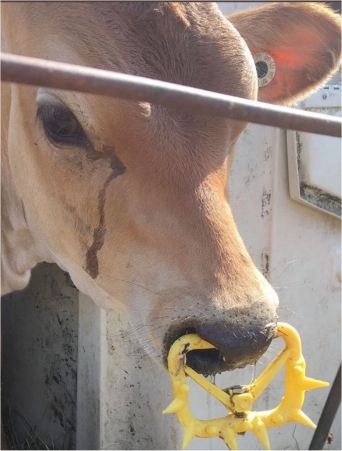
As I understand it, these are mainly used on beef farms where calves do remain with their mothers until weaning. On dairy farms calves are typically separated from their mothers very early on (and this itself is a welfare measure).

The reason farmers use these rings is because calves don’t wean naturally on a farm. They will continue to suckle, which means the mother will continue to produce milk. Just as humans can physically produce milk for 5 or more years if a mother continues to feed her toddler and preschool aged child, a cow will also continue to produce while being suckled – but often at the detriment of her own health.

In the wild, the young would either be pushed out of the herd if male (to go find its own herd), or if female impregnated by the dominant male! On a farm, there are three options for weaning: complete separation while young (as in a dairy), separation at weaning age (between 5 and 12 months depending on the farm process), or using a device like this to allow the mother and calf to stay together but allow weaning.

While it might seem that the nose ring is the crueler of the three options, it’s actually the option that causes the least stress to both mother and calf. Weaning by separation causes a lot more stress on both in the short term but is completed much quicker. But it also requires a bigger land opportunity. You can’t just move either mother or calf into a different paddock if they are still in eyesight or earshot of each other as they will break through fences to get back to each other.

In the wild, nature takes care of itself through harsh measures. In domestic situations, humans must intervene and simulate the conditions that would occur in the wild. The nose ring (which is plastic and is a squeeze fit rather than a pierced fit) pemits a safe and efective way to wean the calf while allowing both to remain in contact.

In closing, let me hasten to add I am not proposing that vegans and animal rights activists advocate for welfare on the grounds that this make animal use perfectly fine. On the contrary, we should wish to prevent animal farming whenever that is possible – good welfare does not mean that we have the right to indiscriminate use of other animals. Rather, I am suggesting that to respect the rights of animals that do exist on farms, we should support policies and standards that aim to improve their welfare. When such conditions fall short, we should call attention to these failings and seek better.