Should Vegans and Animal Rights Advocates Support Better Welfare in Animal Farming?

The simple answer: Yes.

The longer answer: Many animal advocates express concern and outrage at the way animals are treated in even high welfare animal farming operations and certainly there are many examples where “welfare” practices are more about expedience and productivity than the well-being of the animals. However, while we can question some practices, the larger question is, should we openly encourage and support farmers to provide good welfare for their animals or is this tacitly endorsing animal exploitation?

At the heart of this question seems to be the idea of abolitionism vs welfarism, an idea that has been expressed most strongly by animal rights advocate Gary Francione and his stance against what he terms “New Welfarism”. Welfarism is the idea that animal use is acceptable, providing the animals are well cared for. Abolitionism on the other hand is the idea that the foundational right that other animals should attract is the right not to be property (ie to be free) and hence no animal use is morally acceptable, regardless of how well cared for the animals might be.

Welfarism does not necessarily demand an end to animal use, while abolitionism does. Francione worries that by combining the two ideas, we dilute the effectiveness of campaigning for animal liberation (ie, abolition of animal using industries). Such a combination he refers to as “New Welfarism”.

New welfarism is thus an approach which advocates for improving animal welfare whilst still aiming for animal rights and abolition of animal use. Francione is critical of this ‘soft option’ and argues that to ever achieve anything the animal rights movement needs to focus only the ultimate goal of total animal liberation and nothing else.

Moreover, Francione argues that by advocating for, and supporting, better welfare practices we are in essence condoning animal use. The idea that we should think that animal use is acceptable so long as the animals are treated well is a pernicious one to be resisted at all costs. Welfarists are not commited to abolishing animal use and hence have no place within a genuine rights-based framework.

Is this a reasonable strategy? My own view is that no, it isn’t because I believe it confuses welfare with welfarism. The former is entirely consistent with a rights-based framework for our relationship with other species, the latter disregards these rights. This is because when we worry about the wellbeing of animals we are not necessarily committing to the belief that their use and exploitation is acceptable.

To explain further, it is my view that we owe other species the same basic rights as we owe human beings, whenever we can do so (or choose to). The reason for the somewhat optional stance here is because for now, such rights are not formalised at law and hence the best any of us can do is choose to act as though these rights exist.

These basic rights – the rights to be free, in control of one’s own life and not to be treated cruelly – should serve to guide us in our actions. Because these three basic rights give rise to the concept of veganism (and indeed directly underpin the definition of veganism), vegans therefore are people who behave as though other animals have these rights (ie vegans seek to exclude – as far as is possible and practicable – all forms of exploitation of, and cruelty to, animals).

How does this guide us in relation to animal welfare?

Generally speaking, vegans will not support animal-using industries when they can choose otherwise because these industries typically violate all three basic rights. This lack of support usually takes the form of not buying products from animal-using industries so as to remove the stimulus for continued production.

If everyone followed this strategy, then clearly the animal-using industries would cease because economic support is withdrawn. However, for now this is not stopping animals being bred into the system and so there are animals in these industries whose most important basic rights have been violated. The only remaining right that people can help protect is their right not to be treated cruelly.

Therefore, while there are farmed animals, vegans seem to remain under a duty to advocate for better welfare in order to be consistent with the aim to prevent cruelty. By advocating for better welfare one is not endorsing the use of animals in animal-using industries but rather seeking to minimise violations of living animals’ rights (ie the right not to be treated cruelly). Of course, as noted above vegans are still not going to buy products from these industries, no matter how good the welfare.

We can see therefore that these industries would not continue just because these same non-consumers support their welfare efforts. On the other hand, a genuine welfarist – who argues that animal use is fine so long as welfare is fine – would continue to stimulate production with their economic support.

On these grounds, I think vegans should advocate for farmers to maximise welfare. In fact, some typical practices that vegans disapprove of should be endorsed rather than criticised. Let me offer two examples to which vegans/activists frequently object.

The first is AI (Artificial Insemination) and cow/calf separation in dairy farming. Critics regularly refer to this using highly perjorative language, frequently using human sensibilities to describe these practices. It is not uncommon to see advocates/activists talking about “rape”, “rape racks”, “fisting” and so on in order to cast the famers who use AI as something akin to sexual offenders. Clearly the aim is to arouse a negative sentiment in the observer such that they might be willing to consider abandoning dairy products.

I can understand the reasoning but given the actual benefits of AI in this context, it seems unfair to criticise farmers for doing this. Worse, it encourages anti-vegan objectors to ridicule activists for conflating human moral concerns with animals (and the consequent risk that activists are regarded as minimising concerns for human issues).

Instead I suggest that to be consistent with our duty to respect the rights of other animals, surely we should want farmers to take whatever steps are necessary to ensure the overal wellbeing of their animals, once they exist? In the case of dairy AI and cow/calf separation, the benefits include minmising the risk to the cow of being injured during mating, the use of sexed semen to minimise the problem of bobby calves, while also helping to reduce the risk of disease transmission to the calf, ensure adequate colostrum and feed intake, and to simplify disease detection.

Another example is the use of studded nose-rings in calves to prevent them suckling. Activists point to this as particularly inhumane and on the surface, it does look that way. Imagine hooking a pointed object into a calf’s nose to prevent it suckling from its mother? This seems the height of cruelty. Yet is it really?
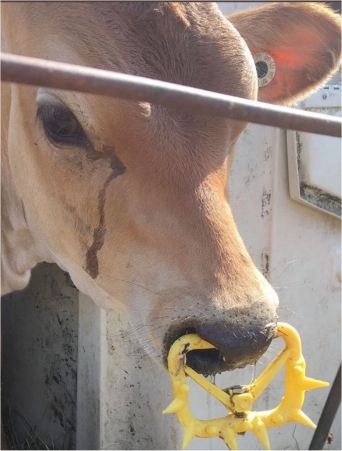
As I understand it, these are mainly used on beef farms where calves do remain with their mothers until weaning. On dairy farms calves are typically separated from their mothers very early on (and this itself is a welfare measure).

The reason farmers use these rings is because calves don’t wean naturally on a farm. They will continue to suckle, which means the mother will continue to produce milk. Just as humans can physically produce milk for 5 or more years if a mother continues to feed her toddler and preschool aged child, a cow will also continue to produce while being suckled – but often at the detriment of her own health.

In the wild, the young would either be pushed out of the herd if male (to go find its own herd), or if female impregnated by the dominant male! On a farm, there are three options for weaning: complete separation while young (as in a dairy), separation at weaning age (between 5 and 12 months depending on the farm process), or using a device like this to allow the mother and calf to stay together but allow weaning.

While it might seem that the nose ring is the crueler of the three options, it’s actually the option that causes the least stress to both mother and calf. Weaning by separation causes a lot more stress on both in the short term but is completed much quicker. But it also requires a bigger land opportunity. You can’t just move either mother or calf into a different paddock if they are still in eyesight or earshot of each other as they will break through fences to get back to each other.

In the wild, nature takes care of itself through harsh measures. In domestic situations, humans must intervene and simulate the conditions that would occur in the wild. The nose ring (which is plastic and is a squeeze fit rather than a pierced fit) pemits a safe and efective way to wean the calf while allowing both to remain in contact.

In closing, let me hasten to add I am not proposing that vegans and animal rights activists advocate for welfare on the grounds that this make animal use perfectly fine. On the contrary, we should wish to prevent animal farming whenever that is possible – good welfare does not mean that we have the right to indiscriminate use of other animals. Rather, I am suggesting that to respect the rights of animals that do exist on farms, we should support policies and standards that aim to improve their welfare. When such conditions fall short, we should call attention to these failings and seek better.

What are “Strong” and “Weak” Veganism?

A few people have taken us to task for promoting the idea that people do not have to be strict vegans. Or as we have put it, that people can adopt “weak” veganism. I would like to explain what we mean by “strong” and “weak” veganism.

The core concept that guides us here at JustUs Too is that veganism is not some strange new moral philosophy, but rather the idea that we extend moral consideration to other species. More exactly, we think of veganism as including other animals within the scope of our moral concern for fairness and justice. In effect, that means regarding other animals as having the same basic three rights as people – the rights to be free, to in control of one’s own life and not to be treated cruelly.

Why “rights”? Well, it’s because we believe that in a similar fashion to the concept of human rights, rights for other animals is simply a way of describing how we should wish to treat them. Rights represent essential moral principles that we think can be applied not only to people but also other animals.

Human rights recognise the inherent value of each person, regardless of background, where we live, what we look like, what we think or what we believe. They are based on principles of dignity, equality and mutual respect, which are shared across cultures, religions and philosophies. They are about being treated fairly, treating others fairly and having the ability to make genuine choices in our daily lives. Likewise, regarding other animals as having these same basic rights is a way to recognise the inherent value and dignity of other species and aim to treat them fairly by our choices whenever we can (or choose to).

With this in mind, let’s look at the generally accepted definition for veganism. The UK Vegan Society defines veganism as:

“A philosophy and way of living which seeks to exclude—as far as is possible and practicable—all forms of exploitation of, and cruelty to, animals for food, clothing or any other purpose; and by extension, promotes the development and use of animal-free alternatives for the benefit of animals, humans and the environment. In dietary terms it denotes the practice of dispensing with all products derived wholly or partly from animals.”

Most vegan advocates believe in following this definition in a very strict fashion. They simply refuse to buy or use anything derived from another animal as much as they possibly can. Many will not, for example, eat a potato chip cooked in the same oil as a piece of chicken or they will refuse to eat oysters because oysters are an animal. This is a very simple and easy way to interpret and adopt veganism as a direction for living. We call this “strong” veganism and it is available to anyone.

However, the definition for veganism can be seen to rest upon the same basic rights-based foundation that we promote here at JustUs Too. The UK Vegan Society’s definition explicitly states that the aim is to prevent all forms of exploitation and cruelty to animals, which is precisely what the three basic human rights set out to achieve for humans and which – when applied to other animals – achieves what the Vegan Society aims to achieve by veganism.

Now, in many countries, human rights are enforced at law and so we can expect a fairly standard range of behaviours from members of these societies. However, such rights for animals are not generally enforced at law and people are free to make their own choices about whether they respect these rights. In that way, “animal rights” do not necessarily mean that everyone will adopt the same behaviours or make the same choices. For some people, it may be just too hard in their particular circumstances or they may simply not be willing to go that far.

However just because someone cannot or doesn’t want to be a strict vegan doesn’t mean that they have to give up entirely on being fair to other animals whenever they can. Rather they can use the concept of animal rights as a guide to what to do when it comes to their actions, such as buying decisions. For example, while animals on high welfare, free-range farms may not be truly free or able to exercise bodily autonomy, they may be relatively free to live natural lives and treated well. Buying products from these farms may be considered a fairer act than economically supporting CAFO systems.

We call this “weak” veganism. Anyone at all can adopt the guiding principles of veganism – basic rights for other animals – and so long as they genuinely mean to do what they can to treat other animals fairly then we believe they are acting consistently with the principles of veganism.

To offer an admittedly extreme example, someone may have decided that for their health they will adopt a carnivore diet. Now, on the face of it this is directly inconsistent with veganism, but just the same that doesn’t mean that they cannot want to make fair decisions about what they do. They might still choose to buy products not tested on animals, they may buy only second hand leather and woollen products, they could even buy meat from high welfare grazed animal systems. We would regard such a person as endorsing weak veganism.

To sum up then, strong veganism is when someone follows the UK Vegan Society’s definition to the letter, while weak veganism is when someone uses the underlying moral principles to guide the choices they make. In the end, people are free to make whatever choices they wish but aiming to be fair to other animals is within everyone’s reach.

JustUs Too encourages everyone to want to be fair to other animals.

A Justice Movement for Animals

*Pinned Post. Newer posts are below this*

Just Us Too is a blog about justice for other species: we promote the idea that people should be fair to the rest of the animals with whom we share the planet. When we get down to it, this is simply about recognising that other animals matter in and of themselves. Long ago before we invented agriculture and settled societies, the animals in the world were all free. That is much less so now, particularly for most of the animals we farm for food, and of course our impact on nature is often harmful to wild animals as well.

Luckily there is an ethical philosopy that can help us here – veganism. Veganism is the idea that we be fair to other animals and do what we can, when we can, to prevent treating them unjustly. I think we can summarise this as:

“Veganism recognises the inherent value and dignity of other species and aims to treat them fairly by our choices whenever we can. It has just two aims – to keep animals free and protected from our cruel actions when we can do that.”

I know that veganism has a pretty tainted reputation, but I believe that the ethical principles of veganism represent the most rational and effective way to be fair to other animals. If you think that other animals matter and that maybe we can do more for them, please read on below.

You can also download my short booklet, Animals Matter. This booklet explains quickly and simply what veganism is, why it’s worthwhile and tackles some typical criticisms. Please feel free to share.

Animals Matter: Veganism for Everyone (pdf, 440kb)

Simply Vegan

Someone asked me for a simpler overview of how veganism could relate to them as an everyday person. Cut to the chase they said, make it simple for me. So, here’s my best shot at a simple guide to veganism, my way.

“Veganism recognises the inherent value and dignity of other species and aims to treat them fairly by our choices whenever we can”

Humans have always used and eaten other animals and in a natural setting there is absolutely nothing wrong with that. That is, I suppose, life. However, something drastic happened to the world over the past 10,000 years – human beings have come to own the whole place. In the process, I believe that we humans have become separated from a natural relationship with other species, now regarding many as mere things – resources – to be used however we want. And that seems unfair when we observe that other animals exist for their own ends the same as we do. We really should be fairer to them.

As I see it, veganism is a very simple idea about our modern relationship with other species which seeks to restore some justice to that relationship. Boiled down, we should – whenever possible – treat other species more fairly and behave as though they have three basic rights – the rights to their own lives, to be free and not treated as property, and to not be treated cruelly. In a sense, we could regard them as fellow citizens of a sort and not just “animals”. And that is pretty much all there is to it.

With this in mind, all that one needs do is make choices that best reflect that ethic. For example, farmed animals are not free, often have no control over any part of their own lives, are treated as property and can be (and often are) treated cruelly. So someone who believes we should treat other animals fairly – as though they have those three basic rights – will choose not to buy products made from farmed animals because their dollar then goes to stimulate the animal-using industries to continue. That’s really the main reason why “vegans” don’t eat meat. Eating animals usually involves buying animal parts derived from farming operations. Similarly they would aim to buy products not tested on animals – again because the animals used in testing are not free, are treated as property, and are treated cruelly.

People often point to grazing cattle and say what pleasant lives they have, safe and cared for by the farmer. That might be true, but maybe 90-95% of all the farmed animals in the world are not out in the fields. They are indoors in CAFOs – Concentrated Animal Feeding Operations. The very first step someone could take would be to stop buying food produced in those systems. Imagine if we could stop all of these unpleasant ways to farm animals!

There seems to be a million websites out there offering advice and guidance on how to be vegan-friendly. The aim is to act in ways that help to prevent the violation of the rights of other species whenever you can. A simple rule of thumb might be to think whether something would be wrong if done to a human. If so, it is probably wrong when done to another animal. Of course, sometimes we simply cannot help but do wrong by other animals but we can try to do the best we can. In the end, the choices you make are up to you in your circumstances.

By the way, earlier I put the word vegans in quotes. That is because I am not much hung up on labels or special tribes. Anyone can embrace vegan ethics and really, it’s up to you how you do that. I tend to think that if you are genuine about wanting to help restore justice for other species then you will do your best in your circumstances. And you can always learn and do more as time passes. So, you don’t have to “go vegan”, “be” a vegan or whatever, unless that is how you wish to identify. In fact, I tend to reserve the word vegan for those who both support the ethical practice AND advocate for justice for other species. In the same way that suffragettes and abolitionists advocated for justice for people, so too can vegans advocate for justice for all species.

I have written about these ideas in more detail here if you would like to know more:

The Philosophy of Ethical Veganism Explained

So Why Veganism

The Problem for Veganism of Crop Deaths

Is Veganism Really Least Harm

Is Veganism Really “Least Harm”?

Summary

Vegans often claim they are doing least harm (or even no harm!) to other species, but critics point to animals killed in crop farming as evidence this is not true. However, critics misunderstand what vegan ethics aim to do. While we might hope to cause less harm as vegans, that is not why we make many of the choices we do.

Veganism is an idea about justice for other species and consequently our main priority within vegan philosophy is to prevent owning and using them for our own ends. Veganism argues that we are being fair to animals when they are free to live their own lives on their own terms. If animal-using industries were abolished as a result of making vegan choices there would no longer be any harm to the animals concerned. It is to prevent the unfair use of animals that vegans choose not to buy products and services that derive from that use.

In other words, vegans are not specifically trying to reduce or minimise harm when they choose not to buy or use animal products. Reducing harm in such industries is a welfare matter and vegans usually do not make economic choices that support improving welfare. Nonetheless, vegans should support better welfare policies because a secondary priority for veganism is to prevent cruelty whenever possible.

Least harm, on the other hand, is a general ethical principle for finding the better path when two or more options for doing something are not beneficial. One can weigh up the options and choose the one which results in the least harm (or at least, harms the fewest). This might be relevant when making purchasing decisions about vegan-friendly products. For example, while we should remain aware that animals are harmed when growing crops, there may be some ethical justification for controlling pests.

Vegans should avoid claiming that we seek to do least harm by buying plant foods rather than animal based foods because that is not our intention nor is it necessarily true. Least harm more correctly describes how we should approach choices about vegan-friendly products because we also wish to prevent cruelty whenever possible and practicable.

**************************************************

The Full Story

A common claim is that by being vegan someone is doing least harm to other species, but critics point to animals killed in crop farming as evidence this is not true. While it is true that animals are killed in crop farming, the criticism misses the point.

First up it is important to clarify our starting point and this is something that many people misunderstand. When people choose not to buy animal products or take advantage of animals for their own benefit, they aren’t really doing so to reduce or prevent harm to other animals. Instead, they are responding to a different ethical imperative – the wish to prevent the unfair use of other species. As I frame this imperative, we aim to treat other species justly by according them basic rights whenever we can. This is our primary duty within the vegan philosophy.

Consider dairy milk as an example case. It is not because cows are harmed that vegans choose not to buy milk but rather because the cows are used as a means to an end; that is, they are exploited. Buying dairy milk contributes to that happening and so vegans choose not to. The problem of harm and suffering by cows is not relevant in this regard. That is a welfare issue. If we could eliminate the ownership of cows to produce milk, there would be no welfare concerns. We can see from this example that vegans aren’t trying directly to reduce or prevent animals being harmed by animal using industries, instead they are seeking to prevent these industries from using animals in the first place.

Our secondary duty is to prevent cruelty to other animals whenever we can. We should want to support efforts to do this and there are situations in which the welfare of other animals is all that we can affect, for example having policies in place to protect domestic companion animals. Nonetheless, vegans do not make choices that send economic signals to industries to enact better welfare. That is, they aren’t likely to buy milk from a more ethical producer. Vegans are not aiming to reduce harm or achieve “least harm” in animal using industries. Their aim is to abolish those industries.

Next we should understand what is really meant by “least harm”. Broadly speaking, least harm is a general ethical prinnciple that aims to find the better path when two or more options are not beneficial. To help us decide which we should choose, we can examine the options and determine which one will result in the least harm (or at least, harm the fewest).

As explained above, vegans are not placed in the position of choosing between the two options of buying or using products from either animal farming or crop farming. Rather we are responding to a question of justice when we choose not to buy or use animal products (by acting as though other species have basic rights). Were we successful in preventing all animal exploitation no animals would be harmed by these industries (as they’d no longer exist).

To put this another way, we aren’t choosing to avoid products from animal-using industries in order to do less harm than products from some other industry. This can be illustrated by considering the case of almond milk. Almond milk is an alternative food to dairy milk, but vegans don’t drink almond milk because it is less harmful than dairy. We drink almond milk because it doesn’t require exploitation of another species.

Vegans are more likely to confront the least harm principle when buying or using vegan-friendly products that may have required harms to other species. For example, growing crops to replace animal products can cause many animals to be harmed and killed. There are several possible ways this can happen. First, because of land clearing to make room for crops; second, from on-farm activities such as harvesting; and lastly from pest control. Both land clearing and on-farm activities are necessary but the deaths of other animals are somewhat incidental. That is, we don’t set out to harm other animals by growing crops. Still, animals will be harmed and this should be considered because vegans should be seeking to prevent cruelty to animals.

Pest control is a major ethical concern for vegans as it is possible that very many animals are harmed and killed from pest management activities, especially if we include invertebrates. Worse, the impact of pest control has affected entire species and ecosystems, so clearly we have an ethical concern. I have explained elsewhere that we may be able to somewhat mitigate this concern in terms of our right to defend ourselves. Briefly, we have the right to produce food and defend its production. It seems less of an ethical failure to grow crops rather than use other animals, even if pest animals must be killed to protect our crops. In particular, it might be the case that in this context we owe a lesser ethical duty to some species than others.

Some have suggested that vegans are under an obligation to make choices that cause least harm when it comes to the foods that we eat where we are doing so merely for pleasure (eg cake or ice-cream). If it goes – critics argue – that we buy a cake for the pleasure of eating it and animals are harmed to produce that cake, then we should choose not to buy the cake on the grounds that doing so causes harm to other animals. We should either forego the cake or simply buy foods that have a lower harm attached to their production.

This seems reasonable, but on practical grounds may be something of a red herring. After all, we really don’t have enough information about whether we are causing more animals to be killed by buying a cake (discretionary) versus a kilogram of lentils (non-discretionary). There is no practical way to say whether it is better or worse to eat one thing or the other as part of a vegan-friendly diet. It seems wrong to buy an unnecessary food and cause animals to be killed, but in the end we can’t be certain whether it makes any difference at all. Nonetheless, I believe that vegans should keep such concerns in mind and make the best choices we can. And we should be open to learning more whenever we can.

In summary, I don’t think vegans should appeal to the ethical principle of “least harm” to defend veganism because that is not our direct intention nor is it necessarily true. At best, this principle is useful in guiding us to make good choices when available options will all cause harm. Least harm more correctly describes how we should approach choices about vegan-friendly products because we also wish to prevent cruelty whenever possible and practicable.

So Why Veganism?

Summary:

Long ago before people developed agriculture and civilisation, humans and other species shared the world as relatively equal participants in the enterprise of life. Veganism wasn’t necessary as we were all born free and able to pursue our own lives on our own terms. We changed all of this beginning around 10,000 years ago with the emergence of agriculture and later civilisation. The world of today is very different as a result. People now often use other species in whatever ways they wish, treating these animals as mere things to be used for our own ends. In doing so, we obstruct and prevent many species from the freedom to live their own lives. Other species exist to pursue their own ends just as we do. There is no reason to think that their wish to flourish is somehow less important than our own. While veganism wasn’t necessary in the distant past, today it is an idea that aims to restore some balance, indeed justice, to the relationship between humans and other species. All that veganism asks is that we make choices whenever we can that respect the rights of other species to live their own lives. In the end, veganism is about us more than it is about the other animals.

*****************************************************************************

The Full Story

In previous posts, I have described veganism as an idea about ethics – we should extend our moral consideration to include other species whenever we can. As I explain it, we can think of other species as having the same basic rights as humans and so, when it doesn’t intrude on our right to look after ourselves, we should treat other species accordingly. In this post, I’d like to explore where I think this idea comes from. Not so much in detail but rather as a general consideration of a fundamental change in our relationship with other animal species.

In the past – that is before the emergence of agriculture and settled, stable human cultures – there was no need for veganism. At that time, humans existed as an integral and relatively equal partner in the enterprise of life. Nearly all species were born free to make their own ways in the world and to live their lives on their own terms subject to the risks and constraints of natural living. In that world, humans depended on other species as natural resources available to them, much as did many other species. Using other animals for food, fibre, tools, etc has been an essential part of human culture for as long as there have been humans to have culture. For all of human history, it has been normal and natural for humans to use other animals in these ways.

However, human beings are a materially different species from all others with the capacity to affect the natural world far more than most other species. For much of our history, this effect was limited but nonetheless at times significant. Some of our activities may have led to noticeable changes, for example the use of fire to transform landscapes and the hunting – perhaps to extinction – of megafauna. Yet on the whole, we remained as we always had been, members of the natural community.

This changed around 10,000 years ago with the development of agriculture and later with the emergence of civilisation and more recently the use of fossil fuels for energy. Since then, we have seen a remarkable growth in both the scale of activities such as agriculture and also the size of the human population. Today, that somewhat equitable relationship with other species I mention above is very much out of balance. Our needs, wishes and preferences now impact almost every species on the planet. Nowhere is this more apparent than in the case of agriculture which has spread to cover much of the planet’s ice free surface and has affected ecosystems everywhere. We have demoted other species from fellow creatures with the right to pursue their own ends as best they can to nothing more than things, objects we can use as means to our own ends.

There seems to be a fundamental injustice in the idea that humans can use other species in the kinds of ways we so often do. Instead of sharing the natural world as relatively equal partners, modern humans dominate all other species in ways that substantially restrict their freedom to flourish on their own terms. We seem to believe there are no reasons to constrain where, when, how and why we intrude on the lives of all other species that share the world with us. We have become separated from nature, treating all other species as mere things to be used.

While veganism was not a concept necessary in the world of our distant ancestors, I believe that today it is an important idea about restoring some fairness – justice – to our relationship with the rest of nature. The reason it is important is that like us, other species have the right to pursue their own lives for their own ends and not merely exist to be means to our ends alone. All species have the fundamental and basic rights to want to flourish and take part in the world as free beings.

In the end, veganism isn’t only not eating meat or eating a healthy diet or saving the planet, though these are possible consequences. Rather, veganism is an idea about aiming by our actions to restore balance between us and the other species, a balance that once was a hallmark of how we fitted into the web of life.

That is why I think veganism just makes sense.

Is it Time to Focus More on People and Less on Vegans?

I have explained elsewhere why I think of veganism as an ethical matter. Some think of veganism as a diet or a means to improve health or to address climate change, but really these are simply strategies to an end which can be swapped out for other strategies if need be. However when considered as an ethical matter, veganism can never be diminished in its essence.

As an ethical concern, I believe that we can summarise veganism as the idea that other species deserve to be treated fairly by regarding them as having the same basic rights as humans, whenever we can. Of course, human rights are usually protected at law whereas animal rights generally are not. For now, the best we can do is to behave as though such rights exist. That is, we can make choices that limit unfair treatment of other species by not contributing to, for example, using other species as a means to an end or as property or subjecting them to cruel practices.

On these grounds, I think advocating for justice for other species is best approached from the perspective of encouraging people to act accordingly. In other words, advocacy might make greater inroads simply by providing information about how animals are treated unjustly, illustrating how we can prevent these injustices and guiding people towards more ethical practices.

In particular, I think we might do better to move away from the idea that by devoting oneself unswervingly to a very strict set of behaviours one can become “a vegan”. Pursuing the idea that someone should be a vegan entrenches the idea of a division, ie people are vegan or non-vegan. It also helps to precipitate and prolong divisive argumentation about whether one thing or the other is more ethical. On the other hand, eliminating this concept of being a vegan and instead encouraging the idea that there just are people who make ethical choices might reduce this kind of tribalism and even encourage a more positive general opinion about the idea.

Now, I am not suggesting abandoning the labels “veganism” and “vegan”. Instead, I think veganism is the best term for describing the idea of extending our moral consideration to include other species whenever we can. Promoting veganism as an idea about moral consideration and ethical practice provides a consistent foundation for advocacy and general adoption.

Insofar as the term “vegan” goes, I propose looking back to previous social justice campaigns in relation to human rights. In that context, particular labels were attached to advocates/activists seeking social change. Consider abolitionists and suffragettes. The general community didn’t think of themselves as such. Nor when slavery was abolished and women got the vote did people more generally become abolitionists and suffragettes. Instead, once change was achieved, all we had were people as members of the newly extended moral community.

I think something the same could apply to veganism, which after all is really the idea of extending the moral community to include other species when we can. Thought of in that way, a “vegan” might be an actual advocate/activist, someone who goes out of their way to encourage social change. On the other hand, people who are convinced and want to endorse the idea and change their ethical practice are just that. People within a more extended moral community.

Advocacy then is undertaken by vegans who promote veganism by education, illumination and guidance. People wishing to learn from these efforts and who wish to make changes for themselves aren’t vegans, they are just people. There is no need for judging people’s degree of vegan-ness, for gatekeeping the vegan community or for toxic debates about how evil or immoral others are.

We are already, most of us, vegan for other people. And in time, we might all be vegan for other species as well. What progress we can make towards this goal is worth celebrating.

A Possible Defence for the Moral Concern of Killing Rodents and Insects in Crops

I have talked about why I believe that veganism is a an ethical position aligned with everyday ethical views about how we treat others. I have also explained how on these grounds we can evaluate which kinds of food production are most ethical. I concluded that we are almost always better to farm only crops than to farm crops AND other animals.

Nonetheless, pest control in cropping remains a significant concern. Given that we very likely cause substantial suffering and death to invertebrate species in particular and that pest management practices are threatening many species with extinction, I think we have to give further thought to how the decision to grow only crops can withstand scrutiny.

The basis for offering moral consideration to other species really rests on sentience. It can only be the case that we have that kind of ethical duty to other species when we can be reasonably confident that they experience the world from a first-person perspective. That is, there is something it is like to be them. Perhaps we might even restrict our concern to those species that can feel pain.

Today, evidence strongly suggests that many invertebrate species are sentient and some may even feel pain. Given it is possible that quadrillions of insects are killed worldwide each year to grow crops, we seem to be causing considerable harm to pest species such as insects and I have argued that it seems wrong to inflict unnecessary harm and suffering on other species. Where to from here?

One option I will propose is that we take into account certain biological factors. The one I am interested in here is reproductive strategy. Species tend to be either K or r strategists. I know that this idea is less favoured these days as an explanation about survival strategies in species, but as a broad-brush consideration I think it still holds some value. K-strategists are longer lived, have few offspring, care for them longer and invest greater resources in their survival. K-strategists tend to be larger animals. An example is cattle. R-strategists on the other hand are shorter-lived, have many offspring, often invest little effort in raising their offspring and are smaller animals. An example is insects. Rodents are also r-strategists.

Consistent with the natural “intent” inherent in the evolution of these two kinds of reproductive strtagey, I propose that we owe a greater duty to individuals of K-selected species and a lesser duty to individuals of r-selected species. K-strategists tend to experience pain in ways that support behaviour adaptation and learning, leading to greater concern for how the self and any offspring go in the world. R-strategists may not even feel pain in some cases (insects) and often show less concern for individual experiences. As K-strategists hope to achieve species success from individual success, we can see why worrying about each animal as an individual is very important. R-strategists on the other hand achieve species success from an overall maximal reproductive potential – many offspring lead to many survivors, even if many die young (which they do).

At the individual level then, we owe a greater duty to K-strategist individuals than we do to r-strategist individuals. Just the same, in both cases, we owe a collective duty to the species to prevent unnecessary harmful impacts such as extreme thinning of populations and/or extinction. On that view, killing pest insects (and rodents) to protect crops may be defensible on practical grounds (we have to grow food to live and insects threaten our success) and on relative ethical grounds of least harm (the experiences of individual insects matter sufficiently less that we can ignore this concern for all practical purposes – we are doing less harm to kill r-strategist individuals than to kill K-strategist individuals).

However, our duty to the species and the environment is such that we cannot be indiscriminate in pest control when the results affect biodiversity, ecosystems and threaten species with extinction. We should encourage improved pest control techniques in order to minimise risks to insect populations and prevent species extinction, but not feel that we have to apologise for killing individual r-strategist pests.

The problem for veganism of crop deaths

Veganism is an ethical position – the idea that we extend moral concern to other species. Simply put, we should want other animals to be free and in charge of their own lives without being treated badly by us, as much as is possible. These are, if you like, our moral duties to them.

As I have suggested elsewhere, these duties mirror the duties we have to other people as explained in the UN Universal Declaration of Human Rights. We can therefore say that we should treat other animals as though they have the same three fundamental rights as expressed in Articles 3-5 of the Declaration:

  • The right to life and liberty (that is, to be in charge of their own lives and not to be exploited)
  • The right not to be held in slavery or servitude (that is, not to be owned and used as a commodity)
  • The right not to be subjected to torture or to cruel, inhuman or degrading treatment or punishment (that is, not to be harmed unnecessarily)

These three principles should govern our relationship with other species. As a consequence, the moral case for not farming animals like cows and pigs emerges from the first two of these principles. That is, we have a duty to respect their right to be free and in charge of their own lives whenever we can. They should not be treated as commodities and used as a means to our ends, whenever we have the option not to.

According to our third principle, we also have a duty to prevent other beings from experiencing unnecessary cruelty. Generally speaking we believe we owe this duty to each individual and that’s why, for example, animal welfare laws exist. While animals continue to be treated as property and used by us, we still have an ethical duty to ensure they are afforded the best possible welfare under the circumstances.

A criticism often raised when we talk about veganism in the context of food production is the killing of pest animals in cropping. Critics say, for example, that millions of small animals like mice are killed by various practices. Even worse, trillions of insects are killed by the use of pesticides. Don’t we owe the same duty to these animals as we owe to the farmed animals? If not, isn’t it hypocrisy to worry about the farmed animals but not the wild animals that we harm?

We can examine this problem in terms of our three ethical principles. Obviously we have to produce food and we can be certain that as with everything else, we cannot avoid causing some harm to other species. But how much does food production transgress our principles and can we align food production with vegan ethics?

In the case of farming animals, we seem to be violating all three principles. That is, farmed animals are owned and exploited, they are not free and they are harmed. Perhaps we could overlook this if we had to farm animals, but clearly we can grow plants for food instead, at least much of the time.

If we choose to grow crops for food rather than also farming animals, we seem likely to be violating just one of these principles when we cause harm and death to pest animals. How so? First, the wild animals managed as pests are free. Secondly, we have a right to protect ourselves; that is, ethically we may kill another in self-defence. Pest animals threaten our well-being by attacking our food supply and may not be reasoned with so we are within our rights to kill them. In the end, it seems we might only be guilty of causing unnecessary pain and suffering. While this is still an important problem, as consumers we may be hard-pressed to either buy foods that aren’t the result of such practices or influence how farmers treat pests.

It seems therefore that it is a lesser ethical failure to only grow crops for food than to grow crops AND to farm animals. Nonetheless, we might hope to buy plant-based foods that require minimal pest management and/or support pest control practices that minimise harm to pest species.

The Philosophy of Ethical Veganism Explained

My explanation of just what ethical veganism really is.

Summary:

Veganism is an ethical position, the idea that we extend moral concern to other (sentient) species. We are already vegan to other people, all that is in question is how much we can be vegan to other species.

Over thousands of years humans have developed moral principles about how to live well together. Some of these principles have been described as human rights and the Universal Declaration of Human Rights sets out a generally agreed set of such rights that can and should apply to all people in any society.

The basic, or foundational subset of these are the three rights described at Articles 3-5 of this Declaration. These are the rights to one’s own life, the right to be free and not treated as property or exclusively as a means to an end, and the right not to be treated cruelly.

There are reasons to believe that these basic rights can be extended to many other species. Simply put, we should want other species to be free and in charge of their own lives without being treated badly by us, as much as is possible.

While human rights are often protected at law, animal rights are not. Vegans therefore are people who behave as though these rights for other species are protected. This makes it very easy to work out what to do whenever we can, even if it turns out that the best that we can do can never eliminate the use of other animals for human ends.


The Full Story

Humans have long been engaged in an ethical project (cf Philip Kitcher). Today it is accepted that people deserve certain moral considerations such as to be free to conduct their own lives, to not be tortured or subjected to cruel, inhuman or degrading treatment or punishment, to not be held in slavery, and to have their interests protected at law. People also deserve to be treated justly. Justice is understood to mean fair treatment and for the victims of unfair treatment to be protected (and perhaps for the perpetrators of unfair treatment to receive punishment).

These ethical principles have been embedded in what are known as human rights. In particular the UN’s Universal Declaration of Human Rights sets out in 30 articles the fundamental human rights to be universally protected. Generally speaking rights and just treatment are confined to our species.

Ethical Veganism is the idea that the principles expressed by three of these fundamental rights – Articles 3-5 of the Declaration – should be extended to other species whenever possible. Vegans believe that we owe a moral obligation to other species to respect their rights to their own lives, not be enslaved and not be subjected to cruel treatment or torture, whenever we can.

This makes it very easy to evaluate what choices and behaviours we should enact in regard to other species. It also offers a clear distinction about those who endorse veganism and those who advocate for animal rights.

Human rights are protected in law – legislation in many different countries seeks to constrain people to observing these rights. Animal rights however are not well protected in law. Because this is the case, people who endorse veganism behave as though those rights are protected, while animal rights advocates also agitate to have those rights protected in law.

While people who endorse veganism choose to act as though animals’ rights are protected, their behaviours will depend to some extent on circumstances. This means that in some cases, animals may still be used and harmed for human needs.

For example, someone living where access to food is limited might own animals from whom food and fibre is collected or obtained. People living in traditional communities with limited access to modern goods and services might continue to hunt other animals for food and fibre. Animals might be used in the pursuit of medical treatments where the outcome can be shown to benefit many.

Generally speaking however, when one lives where circumstances permit then one should make choices that aim to respect and protect the rights of other species. In other words, it is up to the individual how best to act so as to protect other species. For example, they may choose to eat a plant-based diet.

People sometimes argue that farming animals as well as growing crops for food might be preferable to growing only crops. For example, they describe regenerative farming as the most ethical option. It seems to me that this argument is open to debate on empirical grounds, given there is some dispute about the overall efficacy of regenerative agriculture. I cannot adjudicate on that. However, as a broad stance based on my explanation above and within the context of the idea that other species deserve basic rights, it should be clear that animal farming is not ethical.

Our ethical concern in regard to animal farming emerges from its failure to observe the three principles above. We might be able to make farming relatively cruelty free, but we cannot make the animals free or unexploited nor prevent their ultimate harm. Therefore, while minimising pain and suffering in animal farming is consistent with our duty to prevent cruelty, animal welfare in the context of human use of other species falls short of our overall ethical obligation.

Because animal farming fails to fully respect the rights of other species as explained above, people who endorse veganism as an ethical stance will more than likely choose not to buy products derived from animal farming and will prefer to buy and use goods that have been produced without the use and exploitation of other animals, whenever they can. Of course, in the broader sense it might turn out that it simply is not possible to prevent the use of animals completely, if at all, because that is just the way things are. We may simply have to face the fact that whatever ethical failure accrues from this, it is the best we can do in the circumstances.